Overview
The normal matter you and I interact with every day only represents a vanishingly small percentage of the matter in the universe. Far more of the universe consists of "dark matter," a mysterious substance that seems not to interact with normal matter in any way other than gravity. DarkSide-20k is built to hunt for this dark matter.
DarkSide-20k will work by nesting two detectors inside each other - an extremely sensitive time-projection chamber inside a far larger Outer Veto. The two nested detectors will work in concert to rule out cosmic rays, neutrinos, and other environmental radiation in the hopes of identifying elusive dark matter particles.
Technical Details
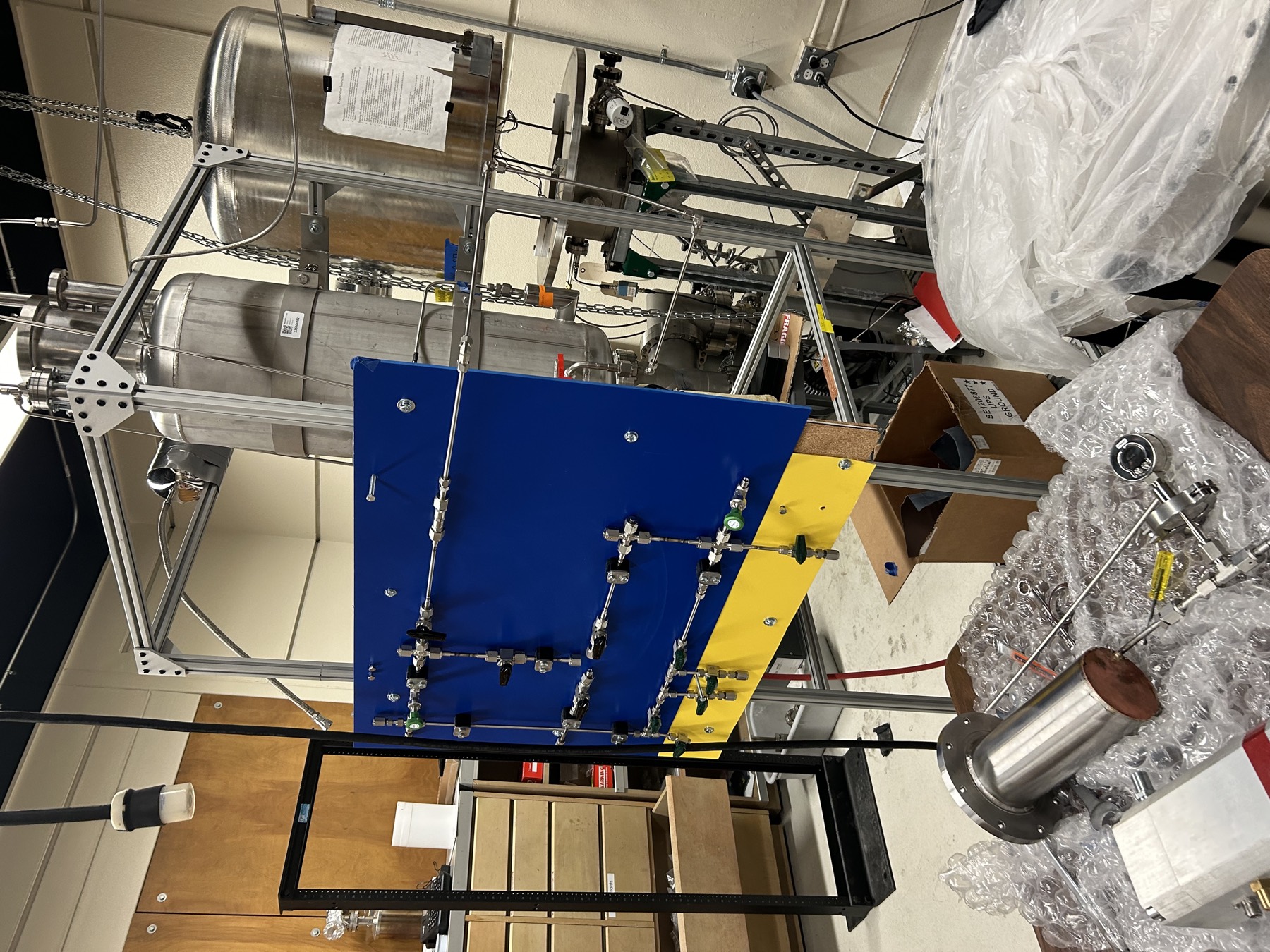
In the Westerdale Lab, we're focused on implementing the Outer Veto. To test our hardware before deployment, we need liquid argon. An inert gas at room temperature, argon needs to be chilled to 87K to liquefy. Our lab operates a condenser to liquefy the argon, and I work on it. I designed and assembled sensor probes that sit inside the cryogenic systems to allow real-time monitoring of the cryogens.
The condenser itself is powered by a 90W pulse-tube coldhead. The coldhead chills a primary stage of nitrogen to 78K, which then condenses the argon in the secondary stage.
Gallery
The Work So Far
The condenser is progressing steadily towards regular operation. Once operational, it will provide liquid argon for ongoing development on DarkSide-20k, as well as insight into LAr-based detector performance with dopants added to the LAr.